

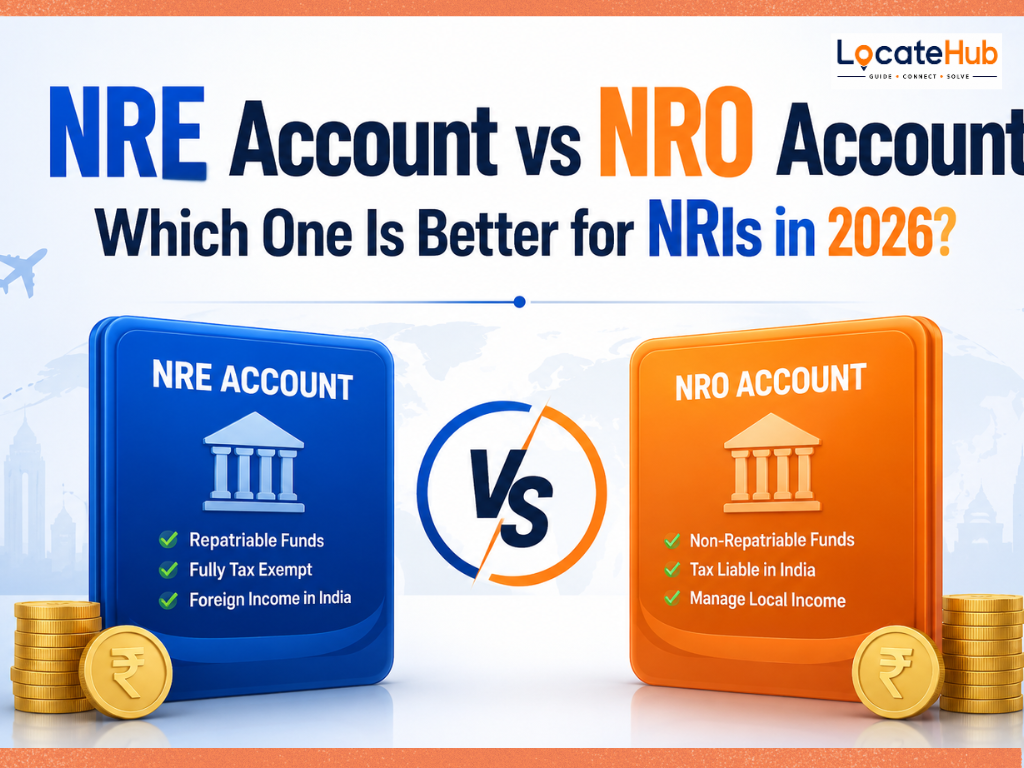
NRE Account vs NRO Account are two different types of bank accounts for Non-Resident Indians (NRIs).
- An NRE Account is used to deposit and manage foreign earnings in India.
- An NRO Account is used to receive and manage income earned in India, such as rent, pension, dividends, and interest.
Although both accounts are maintained in Indian Rupees (INR), they differ in terms of funding sources, taxation, repatriation, and permitted transactions.
Understanding these differences is essential for every NRI to choose the right account and remain compliant with RBI, FEMA, and applicable tax regulations.
Let’s Understand This with an Example
Imagine you move from India to the USA for work and become an NRI.
- Every month, you earn your salary in US Dollars (USD), while your parents continue to live in India and depend on you for their monthly expenses.
- You also own an apartment in Jaipur that generates ₹30,000 in monthly rental income.
Now you have two different sources of income:
- Your salary earned outside India.
- Your rental income earned in India.
Can both incomes be deposited into the same account?
The answer is no.
In this situation, you’ll generally need two different accounts:
NRO Account: Your rental income earned in India is generally credited to an NRO Account.
NRE Account: Your overseas salary is generally deposited into an NRE Account.
Keep reading to learn the complete difference between NRE Account vs NRO Account, including their features, taxation, repatriation rules, eligibility, and which account is better for your financial needs.
Key Takeaways
- An NRE (Non-Resident External) Account is used to manage your foreign earnings in India. Interest earned on the account is generally exempt from income tax in India, subject to applicable laws.
- An NRO (Non-Resident Ordinary) account is for managing your income earned in India, such as rent or dividends. This income is taxable in India.
- Funds in an NRE Account are generally freely repatriable, allowing eligible funds to be transferred back to your country of residence, subject to applicable RBI regulations.
- Funds in an NRO Account can generally be repatriated up to the RBI-prescribed limit per financial year, subject to applicable tax compliance and documentation.
- For most NRIs, having both an NRE and an NRO account is the most practical way to manage finances.
What is an NRE Account?
An NRE (Non-Resident External) Account is a bank account that enables NRIs to deposit and manage their international earnings in India.
Money transferred from abroad is received in a foreign currency and automatically converted to Indian rupees (INR) by the bank.
You can use an NRE account for:
- Receiving your overseas salary
- Sending money to your family in India
- Making investments in India
- Paying expenses within India
- Saving foreign earnings in Indian Rupees
Want to learn more? Read our complete NRE Account Guide to understand its features, taxation, repatriation rules, eligibility, and documents required.
What is an NRO Account?
An NRE (Non-Resident External) Account is a bank account that allows NRIs to deposit and manage their foreign earnings in India.
Typical sources of income include:
- Rental income
- Pension
- Dividend income
- Interest income
- Capital gains
- Salary received in India
- Other eligible Indian-source income
An NRO account helps NRIs manage their Indian income while remaining compliant with FEMA regulations.
Unlike an NRE account, the interest earned on an NRO account is generally taxable in India, and repatriation of funds is subject to RBI regulations, applicable taxes, and prescribed documentation.
Read our complete guide on the NRO Account to learn about its meaning, features, taxation, repatriation rules, eligibility, and required documents.
NRE Account vs NRO Account (Complete Comparison)
| Feature | NRE Account | NRO Account |
| Full Form | Non-Resident External Account | Non-Resident Ordinary Account |
| Purpose | Manage foreign earnings | Manage income earned in India |
| Who Can Open | NRIs, OCIs, eligible PIOs | NRIs, OCIs, eligible PIOs |
| Source of Funds | Foreign income only | Indian income and permitted foreign remittances |
| Currency | Indian Rupees (INR) | Indian Rupees (INR) |
| Foreign Currency Conversion | Automatically converted to INR | Foreign remittances are converted to INR where applicable |
| Interest Taxation | Generally tax-free in India (subject to applicable laws) | Generally taxable in India |
| TDS on Interest | Generally not applicable while exemption conditions are met | Generally applicable as per tax laws |
| Repatriation | Principal and interest are generally freely repatriable | Subject to RBI regulations, tax compliance, and documentation |
| Joint Account | Another NRI or eligible resident close relative on a former or survivor basis | Another NRI or eligible resident Indian, subject to RBI regulations and bank policy |
| Best For | Overseas salary, foreign savings, investments | Rental income, pension, dividends, Indian earnings |
| Ideal Choice | NRIs earning primarily outside India | NRIs receiving income from India |
💡 Expert Tip
An NRE Account and an NRO Account are not competitors—they are designed for different purposes. If you earn money both outside and inside India, maintaining both accounts is often the most practical solution.
Use your NRE account for foreign earnings and your NRO account for income generated within India. This helps keep your finances organized while complying with RBI and FEMA regulations.
Detailed Difference Between NRE Account vs NRO Account
While both NRE and NRO Accounts are meant for Non-Resident Indians (NRIs), they differ in several important areas, including the source of funds, taxation, repatriation, and account usage. Understanding these differences will help you choose the right account for your financial needs.
1. Purpose
The biggest difference between an NRE and an NRO account is why the account is used.
An NRE Account is meant for managing money earned outside India, whereas an NRO Account is designed to manage income earned within India.
Example:
Suppose you work in Australia and earn your monthly salary there. You also own a house in Delhi that generates rental income.
- Your salary from Australia should generally be deposited into your NRE Account.
- Your rental income from the Delhi property should generally be credited to your NRO Account.
2. Source of Funds
The type of money you can deposit also differs.
An NRE Account generally accepts eligible foreign earnings remitted from abroad.
An NRO Account is primarily meant for Indian-source income, although it may also receive certain permitted foreign remittances under applicable regulations.
Example:
| Income Source | NRE Account | NRO Account |
| Overseas Salary | ✅ Yes | ✅ Permitted Transfer |
| Rental Income in India | ❌ No | ✅ Yes |
| Pension from India | ❌ No | ✅ Yes |
| Dividend from Indian Shares | ❌ No | ✅ Yes |
3. Taxation
Tax treatment is one of the biggest deciding factors.
Interest earned on an NRE Account is generally exempt from income tax in India, provided you continue to qualify for the applicable exemption under Indian tax laws.
On the other hand, interest earned on an NRO Account is generally taxable in India, and banks usually deduct TDS as applicable.
Example:
Suppose both accounts earn ₹50,000 as annual interest.
NRE Account
- Interest Earned = ₹50,000
- Tax in India = Generally Nil (subject to applicable laws)
NRO Account
- Interest Earned = ₹50,000
- Tax = Generally Applicable
- TDS = Usually deducted by the bank
4. Repatriation of Funds
Repatriation means transferring money from India back to your country of residence.
An NRE Account generally allows both the principal amount and the interest earned to be transferred abroad freely, subject to applicable RBI regulations.
For an NRO Account, repatriation is permitted but is subject to RBI regulations, tax compliance, and required documentation.
Example:
Suppose you have ₹15,00,000 in your account.
NRE Account
You can generally transfer the eligible balance abroad without any monetary limit, subject to applicable regulations.
NRO Account
The transfer is generally permitted upon completion of the prescribed documentation, tax compliance requirements, and RBI regulations.
5. Currency
Both accounts are maintained in Indian Rupees (INR).
However, the way money enters the account is different.
In an NRE Account, funds are sent in a foreign currency and automatically converted to INR.
An NRO Account generally receives Indian income directly in INR.
6. Interest Earned
Both NRE and NRO accounts earn interest depending on the bank and account type.
The main difference lies in taxation.
| Particular | NRE Account | NRO Account |
| Earns Interest | ✅ Yes | ✅ Yes |
| Tax-Free Interest | Generally Yes | No |
| TDS | Generally No | Generally Yes |
7. Joint Account Facility
Both account types allow joint holding, but the rules are different.
An NRE Account can generally be held jointly with another NRI. A resident close relative may also be added on a “former or survivor” basis, subject to RBI regulations and the bank’s policy.
An NRO Account generally offers more flexibility and may be opened jointly with another NRI or an eligible resident Indian, subject to applicable regulations and bank policy.
8. Best Suited For
Choosing the right account depends on where your income comes from.
| If You… | Best Account |
| Earn salary abroad | ✅ NRE Account |
| Receive rent from India | ✅ NRO Account |
| Receive pension from India | ✅ NRO Account |
| Want tax-efficient savings from foreign earnings | ✅ NRE Account |
| Need to manage Indian income | ✅ NRO Account |
| Earn both foreign and Indian income | ✅ Both NRE & NRO Accounts |
Which Account Should You Choose?
The answer depends entirely on your source of income.
Choose an NRE Account if:
- You earn your salary outside India.
- You regularly send money to your family in India.
- You want to save or invest your foreign earnings in India.
- You want eligible funds to be freely repatriable.
- You want to benefit from the generally tax-free interest available under applicable laws.
Choose an NRO Account if:
- You receive rental income from property in India.
- You receive pension from India.
- You earn dividends or interest from Indian investments.
- You receive any other Indian-source income.
- You need to manage your income and expenses within India.
Can You Have Both an NRE and an NRO Account?
Yes. In fact, many NRIs maintain both accounts because each serves a different purpose.
Example
Suppose you work in the UK.
- Your monthly salary of ₹3,50,000 (equivalent) is credited to your NRE Account.
- Your rental income of ₹40,000 from a property in Mumbai is credited to your NRO Account.
- You can use the NRE Account for transferring your foreign earnings to India and the NRO Account for managing your Indian income.
Using both accounts helps you separate foreign earnings from Indian income while complying with applicable RBI and FEMA regulations.
💡 Expert Tip
If you earn only foreign income, an NRE Account may be sufficient. However, if you also receive rent, pension, dividends, or any other income from India, maintaining both an NRE and an NRO Account is often the most practical approach. It helps keep your finances organized and ensures each type of income is credited to the appropriate account.
Common Mistakes NRIs Make While Choosing an NRE or NRO Account
Many NRIs open the wrong type of account simply because they are unaware of the differences between NRE and NRO accounts. Here are some common mistakes you should avoid.
Depositing Indian Income into an NRE Account
An NRE Account is generally meant for eligible foreign earnings. Indian-source income, such as rent, pension, dividends, or interest from India, should generally be credited to an NRO Account.
Continuing to Use a Resident Savings Account After Becoming an NRI
Many people move abroad but continue using their resident savings account. Under applicable FEMA regulations, you should redesignate your resident account after your residential status changes.
Assuming NRE and NRO Accounts Are the Same
Although both accounts are available to NRIs, they serve different purposes.
- NRE Account → Foreign earnings
- NRO Account → Indian income
Understanding this difference helps you choose the right account for each type of income.
Ignoring Tax Rules
Many NRIs assume all NRI bank accounts receive the same tax treatment.
Generally:
- Interest on an NRE Account is exempt from income tax in India, subject to applicable laws.
- Interest on an NRO Account is generally taxable in India.
Knowing these rules can help you plan your finances more effectively.
Not Informing the Bank After Returning to India
Once your residential status changes from NRI to Resident Indian, you should inform your bank and redesignate your NRE/NRO accounts as required under RBI regulations.
NRE vs NRO Account: Quick Comparison
| Particular | NRE Account | NRO Account |
| Purpose | Manage foreign earnings | Manage Indian income |
| Deposit Source | Foreign income | Indian income + permitted credits |
| Currency | INR | INR |
| Tax on Interest | Generally Tax-Free | Generally Taxable |
| TDS | Generally Not Applicable | Generally Applicable |
| Repatriation | Generally Fully Repatriable | Subject to RBI regulations and documentation |
| Best For | Overseas salary & savings | Rent, pension, dividends, Indian income |
Which Account Is Better for NRIs?
There is no single “better” account because both serve different purposes.
Choose an NRE Account if:
- You earn most of your income outside India.
- You regularly send money to India.
- You want tax-efficient savings (subject to applicable laws).
- You may need to transfer your funds back to your country of residence.
Choose an NRO Account if:
- You receive rent from property in India.
- You earn pension or dividends in India.
- You receive interest from Indian investments.
- You need to manage income generated within India.
Our Recommendation
If you earn income both outside India and within India, maintaining both an NRE and an NRO Account is often the most practical solution. It allows you to manage each type of income separately while complying with RBI and FEMA regulations.
Frequently Asked Questions
1. Can I have both an NRE and an NRO account at the same time?
Yes. Many NRIs maintain both accounts because each serves a different purpose. An NRE Account is generally used for foreign earnings, while an NRO Account is used for managing income earned in India.
2. Which account is better for salary earned abroad?
If your salary is earned outside India, an NRE Account is generally the preferred option for receiving and managing those foreign earnings.
3. Can I receive rental income in an NRE account?
Generally, no. Rental income from property in India is usually credited to an NRO Account.
4. Is interest on an NRE account taxable?
Generally, no. Interest earned on an NRE Account is exempt from income tax in India, provided you continue to qualify for the applicable exemption under Indian tax laws.
5. Is TDS deducted on an NRE account?
Generally, TDS is not deducted on interest earned in an NRE Account while the applicable tax exemption continues to apply.
6. Is TDS deducted on an NRO account?
Yes. Banks generally deduct TDS on interest earned in an NRO Account as per applicable tax laws.
7. Can I transfer money from my NRE account to my NRO account?
Yes. Most banks allow transfers from an NRE Account to an NRO Account through internet banking, mobile banking, or branch requests, subject to the bank’s procedures.
8. Can I transfer money from my NRO account to my NRE account?
Such transfers may be permitted in certain cases, subject to RBI regulations, applicable tax compliance, and the bank’s documentation requirements.
9. What happens to my NRE account after I return to India?
Once your residential status changes to resident, you should inform your bank and redesignate your NRE Account as required under RBI regulations.
10. Which account should I choose if I receive both foreign salary and rental income in India?
In this situation, many NRIs maintain both accounts—an NRE Account for their overseas salary and an NRO Account for rental income and other earnings from India.
Final Thoughts
Choosing between an NRE Account and an NRO Account depends entirely on where your income comes from. If your earnings are generated outside India, an NRE Account is generally the appropriate option. If you continue to receive income such as rent, pension, dividends, or interest from India, an NRO Account is typically required.
Many NRIs benefit from maintaining both accounts, as each is designed for a different purpose. Understanding the differences in taxation, repatriation, permitted deposits, and account usage can help you manage your finances more efficiently while remaining compliant with RBI and FEMA regulations.
Disclaimer
The information provided in this article is for educational and informational purposes only and should not be considered legal, tax, financial, or investment advice. While every effort has been made to ensure accuracy, RBI regulations, FEMA provisions, Income-tax laws, and banking policies may change over time. The eligibility criteria, documentation requirements, tax treatment, and repatriation rules discussed in this article may vary depending on your individual circumstances and your bank’s policies. Before making any financial or banking decisions, verify the latest guidelines with your bank, the Reserve Bank of India (RBI), or consult a qualified financial, tax, or legal professional.
