

Updated for the Income Tax Act, 2025, applicable for tax years beginning on or after April 1, 2026.
If you’ve moved abroad and someone’s told you, “don’t forget to change your PAN status to NRI,” the first thing you may have wondered is what that actually means. Does your PAN number change? Do you need a new card? Is this urgent, or can you do it later?
Here’s the honest answer: Your PAN number always remains the same. Your residential status in the Income Tax Department’s records has to be updated. Depending on your situation, moving overseas and having your records still indicate “Resident” rather than “Non-Resident” could lead to problems with tax deductions, refunds, or specific financial transactions.
This guide walks you through everything involved when you change PAN status to NRI — what changed under the new tax rules, how to update your residential status, what documents you may need, and what to do if the process gets stuck.
Key Takeaways
- PAN number does not change when you become an NRI.
- Update your residential status in PAN records.
- PAN-Aadhaar linking and residential status are separate matters.
- Keep your PAN, passport and overseas address proof ready.
- Check your status through the Income Tax e-Filing portal.
- PAN updates do not automatically update bank or mutual fund KYC.
- Eligible NRIs may be exempt from PAN-Aadhaar linking.
- For complex cases, contact your JAO or a qualified tax professional.
What Does “Changing PAN Status to NRI” Actually Mean?
Let’s first clear up the confusion about what it actually means to change PAN status to NRI, because many people misunderstand it.
Your PAN is a permanent 10-character number — it was assigned to you once, and it stays yours whether you’re in Mumbai or Melbourne. There’s no such thing as a separate “NRI PAN card” with a different number. If anyone’s told you that you need a new PAN because you’ve moved abroad, that’s not accurate.
What actually needs updating is the residential status field linked to your PAN in the Income Tax Department’s system, as well as your registered address. Moving abroad does not by itself mean that your PAN records will automatically reflect your current residential circumstances.
If your information needs correction, you should follow the applicable Income Tax Department process. If your PAN records have not been updated, they may continue to show your previous residential-status information until the relevant records are corrected.
One more thing worth separating clearly: changing your PAN residential status is not the same as PAN-Aadhaar linking. These are two separate matters, although they can affect each other in some situations.
Why You Need to Update It — What Happens If You Don’t
Remember that PAN profile information and your legal residential status for income-tax purposes are related but not the same thing. Your tax residency is determined under the applicable residence rules for the relevant financial year; it is worth getting the information reviewed and corrected where necessary. An incorrect residential status record can create complications with tax deductions, refunds, KYC checks, or certain financial transactions. Some of the others are-
The most immediate one is TDS: The type of income or transaction and the tax laws that apply to your situation determine how TDS is treated. The withholding treatment may differ from your real tax position if your residential status or PAN-related information is not accurately reported.
Refunds can also be affected: If your PAN becomes inoperative owing to a compliance issue, a tax refund may be issued until the underlying problem is fixed. The actual impact is determined by the reason for the PAN becoming inoperative and your specific circumstances.
Investments can be affected as well: Before completing some transactions, fund houses, brokers, and other financial organizations may request that your residential status and KYC information reflect your actual circumstances.
The Aadhaar Exemption Trap
Here’s the part that many NRIs may not be aware of. Eligible non-residents are generally exempt from the mandatory PAN-Aadhaar linking requirement, subject to applicable rules and conditions.
However, the exemption depends on meeting the applicable conditions, and keeping your residential-status information accurate can help avoid unnecessary PAN-Aadhaar compliance issues.
If your PAN records do not reflect your actual circumstances, you may need to clarify your non-resident status when dealing with PAN-Aadhaar compliance requirements.
This is why keeping your residential status information up to date is useful, even if you are not required to link your PAN to Aadhaar.
A Real Example With Real Numbers
Suppose you’re an NRI and you sell a flat in India for ₹80 lakh. The tax and TDS treatment of a property sale involving an NRI can differ from the treatment applicable to a resident seller.
If your residential status or PAN-related information is not correctly reflected, the TDS applied at the transaction stage may not reflect the treatment applicable to your circumstances. If excess tax has been deducted, you may be able to claim the eligible amount through the applicable income-tax return or refund process. However, an incorrect or outdated record can create unnecessary delays and additional paperwork.
For a transaction of this size, it is worth reviewing your PAN and residential status information before completing the sale, rather than trying to correct everything afterward.
What’s Changed — The New Income Tax Act 2025 and PAN Rules (Effective April 1, 2026)
If you’re researching how to change PAN status to NRI right now, this is the part most guides on this topic haven’t caught up to yet, so it’s worth understanding properly.
For tax years beginning on or after April 1, 2026, the Income Tax Act, 2025 applies prospectively and replaces the Income-tax Act, 1961 for those tax years. Along with it came changes to the framework governing tax administration and related procedures.
The forms changed. The PAN application forms have also changed under the new framework. The Income Tax Department has introduced new forms for fresh PAN applications filed on or after April 1, 2026. Existing PAN numbers remain valid and do not need to be replaced simply because the new forms have been introduced. Because forms and portal processes can change during implementation, always verify the current form and filing requirements on the official Income Tax Department portal before submitting an application.
Aadhaar alone is not necessarily enough for an NRI-related status or documentation request. Depending on the application and the purpose of the correction, a valid passport, proof of overseas address, and other supporting documents may be required.
A foreign Tax Identification Number may also be relevant. If your country of residence issues a TIN, you may need to provide it for certain tax-related procedures or documentation.
There’s also a procedural change relating to property transactions involving NRIs that may affect buyers and sellers. Because these provisions are relatively new, verify the current TDS and reporting requirements before completing a property transaction.
This section reflects the framework as understood at the time of writing. Given that these rules took effect recently, it’s worth cross-checking the latest notifications on the Income Tax Department’s portal before you file. We’ll keep this updated as further clarifications roll out.
Who Needs to Update the Resident Status of PAN — NRI vs OCI vs PIO
The process to update the resident status of PAN for an NRI and OCI isn’t identical in every situation, so it is important to understand which category you fall under before you start.
This guide is primarily for anyone who already holds a PAN issued while they were a resident of India, and who has since moved abroad — for work, business, marriage, or long-term settlement.
If you’re applying for a PAN for the very first time and you’re already living abroad, you don’t need to “correct” anything — you can apply directly under the appropriate NRI/foreign applicant category from the outset.
Worth knowing: NRIs (Indian citizens abroad), OCI holders, PIOs, and foreign citizens of Indian origin may fall into different applicant categories, with varying documentation requirements and eligibility criteria.
If you hold an OCI card, for instance, your documentation requirements can differ from those of an Indian citizen residing abroad. Always select the category applicable to your citizenship and tax circumstances.
Documents You’ll Need
Keep clear, legible scans ready before you start — incomplete or mismatched documents are one of the biggest reasons these applications can take longer.
- Copy of your PAN card
- Passport showing your identity and, where relevant, overseas stay.
- Valid visa, residence permit, or work permit, where applicable
- Proof of your foreign address
- OCI or PIO card, if applicable
- Tax Identification Number (TIN) from your country of residence, where applicable
- Attestation, where required: certain foreign documents may need attestation by the Indian embassy, high commission, consulate, or another authorized authority depending on the procedure being followed.
What if your passport has no entry or exit stamp?
If your passport doesn’t have a physical entry or exit stamp — increasingly common with countries using electronic immigration systems — don’t automatically assume you’re stuck.
You may be able to provide alternative evidence, such as a visa approval letter, a residence permit, an immigration record, or a digital entry confirmation, depending on the specific procedure. Include a short explanation if the absence of physical stamps could otherwise create confusion.
How to Change PAN Status to NRI — Step by Step
There are several ways to request or update your residential status information, and the appropriate route may depend on your situation and the current Income Tax Department process.
Route How it works Typical timeline Best for
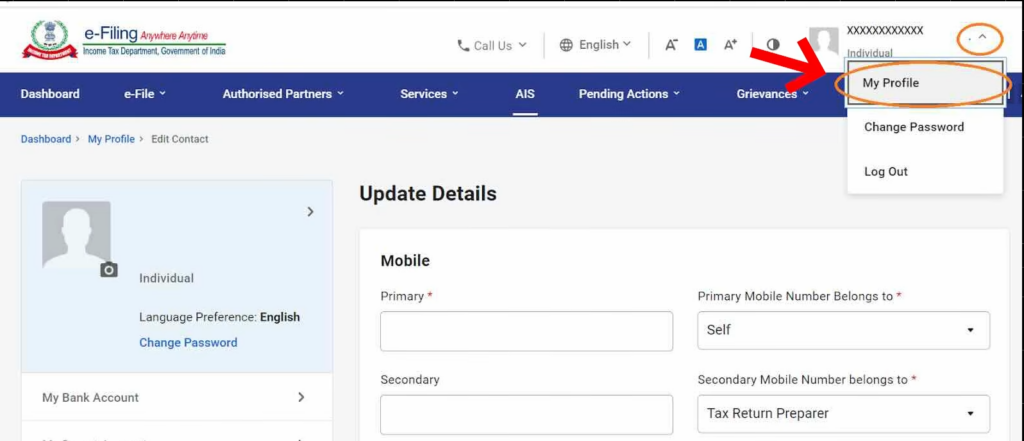
Self-edit via “My Profile” Log in to the Income Tax e-filing portal, open My Profile, edit the available residential-status information, and save Immediate for the profile field, where available First step/checking your profile.
Grievance / e-Nivaran submission Log in, go to Grievances, select the relevant department/category, explain your request and attach documents Can vary depending on the case Cases requiring supporting documents.
Direct submission to your JAO Find your Jurisdictional Assessing Officer via “Know Your AO,” then submit documents with a cover letter Varies by case and AO Complex cases or unresolved requests.
Here’s the important point: simply editing “My Profile” may not always be enough to resolve every underlying tax-record issue. If supporting documentation is required, you may still need to submit a grievance or contact the relevant Assessing Officer.
Official check: The Income Tax Department’s e-Filing portal provides options to update Residential Status through the taxpayer profile. Where an issue requires departmental intervention, taxpayers can also use the grievance facility available on the portal.
How to find your Jurisdictional Assessing Officer
To find your JAO, use the Know Your AO facility on the Income Tax Department portal.
You may need your PAN and other requested details to identify the relevant officer. Note the AO’s name, designation, and contact details in case you need to follow up.
Not sure how to find your JAO? Read our detailed guide on [How to Find Your Jurisdictional Assessing Officer (JAO) Online] to see the complete step-by-step process.
How to submit a grievance
For the grievance route, log in to the Income Tax portal and navigate to the Grievances section.
Select the relevant department and category available to you. Clearly state that you are requesting correction of your residential status from Resident to Non-Resident.
Attach supporting documents and submit the request.
Save the grievance reference number because you’ll need it to track the request or follow up later.
For more details, see our More Guides.
The Step Everyone Forgets — Updating Your Bank, Broker, and Mutual Fund KYC
Here’s something that catches even people who’ve done everything right on the tax side: fixing your PAN records with the Income Tax Department does absolutely nothing to automatically update your bank, demat, or mutual fund records.
Those are separate systems.
Under FEMA, once you’ve become an NRI, your existing resident savings account may need to be converted into an appropriate NRO or NRE structure. See our detailed [NRO vs NRE Account guide] for the difference and conversion process.
How to verify that the changes have reached other systems
Check your CKYC (Central KYC) status. Your KYC classification and overseas address should reflect your current circumstances once the relevant institution has processed the change.
If you invest in Indian mutual funds, also check your mutual fund KYC status separately.
A correctly updated record should reflect your current residential status and overseas address, along with applicable FATCA/CRS information.
These systems do not necessarily update at the same time, so checking them separately can help identify a mismatch before it causes a transaction problem.
How to Check If Your PAN Status Update Was Successful
Don’t just assume your updated PAN status for an NRI request worked because you submitted everything — confirming takes only a couple of minutes.
- Log in to the Income Tax e-filing portal and open My Profile → Personal Details.
2. Check the Residential Status field and confirm that it reflects your current status.
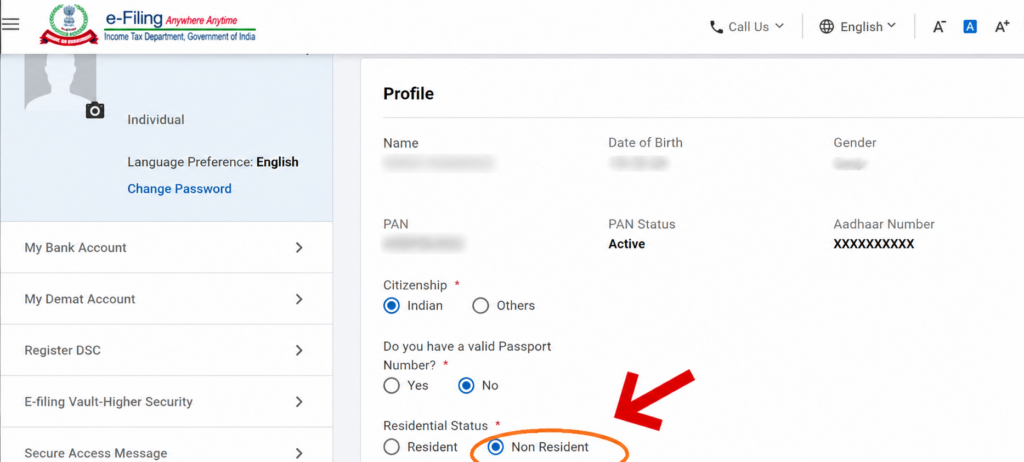
3. Check whether any Aadhaar-related requirement or exemption is displayed for your account, where applicable.
4. Cross-check your CKYC and mutual fund KYC status if you have accounts or investments in India.
If your portal still shows “Resident” after you have submitted a correction request, check the status of your grievance or AO submission before submitting multiple duplicate requests.
My Application Is Stuck — Escalation Path
If it’s been longer than the expected window and nothing’s moved, here’s a sensible way to escalate rather than repeatedly submitting the same request.
- Check your grievance status online using the reference number you saved.
- Review your documents before escalating. Check whether any document is missing, unclear, or inconsistent.
- Raise a new grievance referencing your earlier ticket number if the earlier request has not been resolved.
- Contact your JAO directly using the details obtained through the “Know Your AO” facility.
- Escalate through CPGRAMS if the issue remains unresolved after using the appropriate departmental channels. See our [CPGRAMS overview guide] for more information.
Returning to India? How the Status Reverses
Your residential status for tax purposes isn’t locked in permanently in either direction. It is determined for each financial year based on the applicable residence rules and your physical presence in India.
Broadly, you may become resident under the relevant day-count and income conditions specified under Indian tax law. Because special rules can apply to Indian citizens and persons of Indian origin visiting India, don’t rely only on a simple 182-day test if your situation is complex.
If you become resident again, your tax profile and financial accounts may need to be updated accordingly.
The same downstream logic applies in reverse: your bank, broker and investment accounts may need to be updated when your residential status changes.
For a detailed checklist, see our guide on [NRI Returning to India].
Get Help If You’d Rather Not Handle This Alone
If you’ve read this far and you’re dealing with a stuck grievance, a delayed refund, or a property transaction where your residential status needs to be correct, getting professional guidance can save you from unnecessary delays and repeated submissions.
If you’re unsure how to change PAN status to NRI, consider speaking with a qualified CA or NRI tax professional before your next major filing, property transaction, or tax-related submission.
You can also check your PAN status and review your documents before submitting a correction request so that any mismatches can be addressed early.
Frequently Asked Questions
Does my PAN change automatically when I move abroad?
No. Your PAN number itself does not change simply because you move abroad. You need to ensure that your relevant tax and financial records reflect your current residential status.
Does my PAN number itself change when I become an NRI?
No. Your 10-character PAN remains the same. Your residential status and other relevant details may need to be updated.
Do NRIs need to link PAN with Aadhaar?
Generally, eligible non-residents are exempt from the mandatory PAN-Aadhaar linking requirement. However, the exact exemption depends on whether you meet the applicable conditions. If your records incorrectly show you as a resident, you should get the underlying information corrected.
What documents are required to change PAN status to NRI?
The documents can vary depending on the correction route and your circumstances. Common supporting documents include your PAN, passport, proof of overseas address, and relevant immigration/residence documents. Additional tax identification or attestation requirements may apply.
How long does the process take?
The processing time varies depending on the route, documentation and department workload. Online profile changes may reflect quickly, while requests requiring supporting documents or departmental review can take longer.
My PAN is already inoperative — how do I fix it?
First identify why the PAN is inoperative. If the issue is related to your residential status or another compliance problem, use the appropriate Income Tax Department process and submit supporting documentation where required.
Can I complete this from outside India?
Yes. Depending on the process applicable to your case, you may be able to complete the request online or submit documents from overseas.
Can I switch back to resident status if I return to India?
Yes. Residential status is determined for each financial year under the applicable tax rules. If your circumstances change, update your relevant tax and financial records accordingly.
Disclaimer: This guide on how to change PAN status to NRI reflects the general framework understood at the time of writing, shortly after the Income Tax Act, 2025 took effect. Tax rules and procedural details can change, and individual situations vary. For anything with meaningful financial stakes, such as a property sale or a large refund, it’s worth having a qualified CA or NRI tax professional confirm the specifics for your case before you file.
